

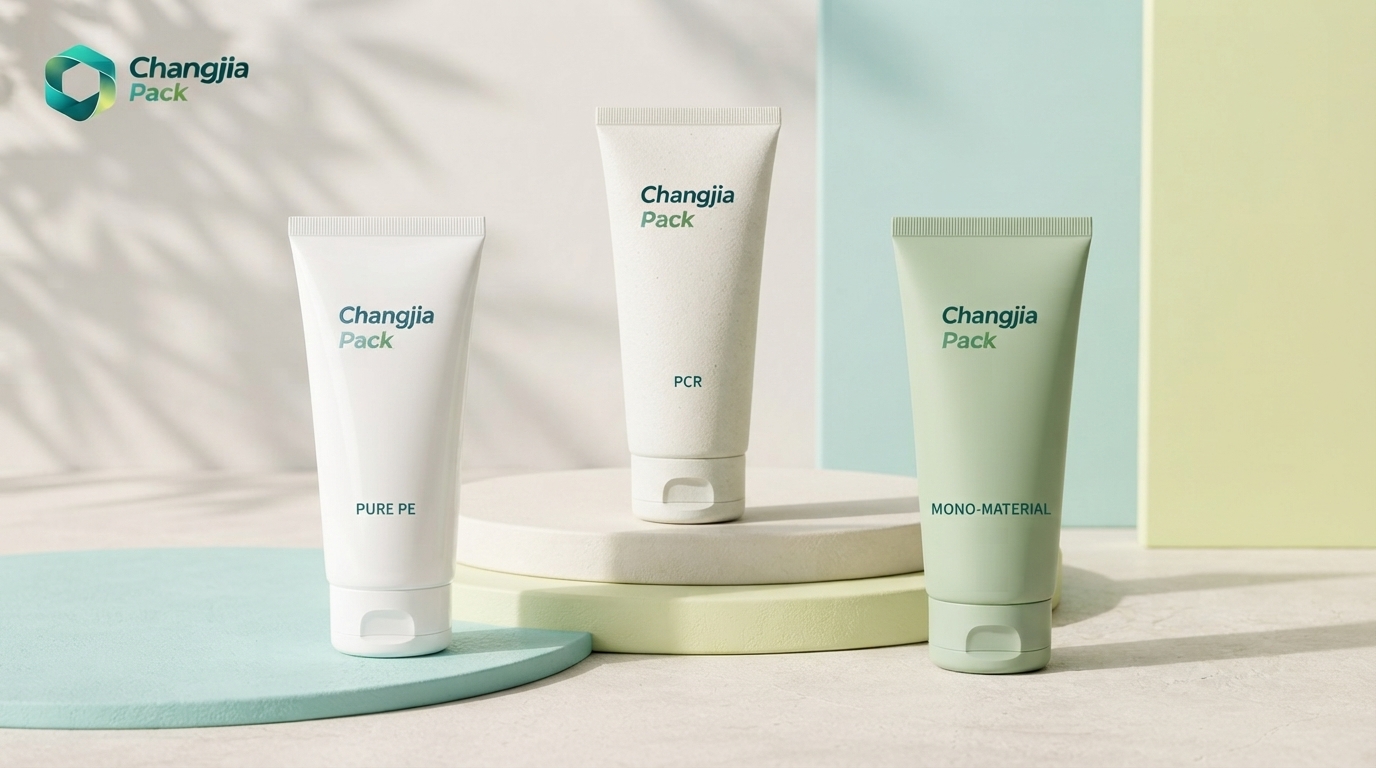
As personal care and cosmetic brands face increasing regulatory and market pressure to adopt sustainable packaging, the decision of which eco-friendly material path to choose becomes highly critical. Two dominant choices have emerged for squeeze-tube packaging: Post-Consumer Recycled (PCR) tubes and 100% Virgin Mono-material Polyethylene (PE) tubes. While both options offer distinct ecological benefits, they perform differently when subjected to rigorous manufacturing, decoration, filling, and recycling processes. For brand managers, procurement heads, and contract fillers, understanding the technical trade-offs between PCR and mono-material PE structures is essential to maintaining product integrity while hitting sustainability goals.
Material Composition and Structural Properties
Post-Consumer Recycled (PCR) tubes are manufactured by blending recycled plastics—typically sourced from municipal recycling streams—with virgin PE resins. The recycled content usually ranges from 30% to 50% depending on the required flexibility and structural performance. In contrast, mono-material PE tubes are constructed entirely from a single plastic family, typically combining different grades of polyethylene, such as High-Density Polyethylene (HDPE) and Low-Density Polyethylene (LDPE). By eliminating foreign polymers from the shoulder, sleeve, and cap, mono-material PE tubes achieve a highly unified composition that simplifies municipal sorting.
- PCR tube bodies rely on a composite blend, which can affect the tensile strength and elasticity compared to virgin resins.
- Mono-material PE designs utilize advanced co-extrusion technology to combine soft and rigid PE layers without relying on secondary materials.
- Sleeve stiffness and squeeze restitution are easier to control with virgin mono-material formulations.
Formulation Compatibility and Barrier Protection
Maintaining the shelf life of active formulations is a primary concern for high-performance packaging. The integration of PCR resins introduces microscopic variances that can affect compatibility with complex formulas, such as sunscreens, skin brighteners, and clinical treatments. For highly sensitive formulations, a co-extruded structure containing a functional barrier layer is required. Virgin mono-material PE tubes excel here by integrating a micro-thin Ethylene Vinyl Alcohol (EVOH) barrier layer. This multi-layer extrusion restricts oxygen and moisture migration while keeping the entire tube within the PE recycling stream. This performance is critical for preserving volatile active ingredients in specialized personal care tubes.
- Virgin mono-material PE with EVOH provides highly predictable oxygen and moisture transmission rates.
- PCR resins can occasionally present odor or trace residue challenges that require meticulous compatibility and migration testing.
- Products with complex oil phases or essential oils demand a stable barrier to prevent package deformation or formula scalping.
Decoration, Printing, and Aesthetic Performance
The choice between PCR and mono-material PE significantly influences the final look and feel of the package. Virgin mono-material PE tubes offer a perfectly clean, predictable surface that easily accepts high-resolution graphics, delicate gradients, and specialty finishes like spot UV or hot stamping. In contrast, PCR material inherently carries slight imperfections, such as tiny dark specks or a warm-gray tint. While some brands actively use these visual cues to signal 'eco-authenticity' on retail shelves, others prefer the flawless pearl, matte, or high-clarity finishes possible only with virgin polymers.
- Offset printing and silk-screen printing achieve sharper registration and color consistency on virgin mono-material PE.
- PCR tubes often require a matte varnish or opaque base color to mask internal material specks and slight yellowing.
- Advanced hot stamping foils adhere more consistently to the smooth, virgin outer layers of co-extruded tubes.
Recyclability Design and Circular Economy Validation
While PCR tubes contribute to the circular economy by utilizing waste that would otherwise end up in landfills, mono-material PE tubes contribute by feeding clean material back into the recycling stream. Traditional multi-material tubes, which mix PE sleeves with PP caps and polyester shoulders, are rejected by automated recycling systems. Designing a tube where the sleeve, shoulder, and closure are all made of PE creates a highly recyclable package. The purity of the recycled output from mono-material PE packaging is highly valued by plastic reprocessors, making it an ideal long-term solution for brands striving for circular packaging designs.
- Mono-material PE tubes qualify for standard PE recycling streams (Code 2 or Code 4 depending on density).
- Incorporating PCR reduces the demand for fossil fuels but requires clean sorting to maintain recycled pellet quality.
- Matching the tube head, sleeve, and closure material maximizes the recovery rate during optical sorting at recovery facilities.
Buyer checklist
- Confirm the exact PCR inclusion rate (typically 30% to 50%) and demand traceability certificates for the recycled resin source.
- Conduct a comprehensive 12-week compatibility and migration test at 40 degrees Celsius with your specific formulation to monitor for delamination or sensory changes.
- Verify that the barrier structure (such as co-extruded EVOH) is tailored to the oxygen sensitivity of your active ingredients.
- Evaluate printing requirements: choose offset printing for complex, photographic artwork, or screen printing for high-opacity colors on textured PCR surfaces.
- Specify a mono-material PE or compatible PP flip-top closure to ensure the entire assembly meets regional recycling standards.
- Test tube-sealing parameters on your production lines, as PCR-blended tubes may require narrower heating windows than 100% virgin PE.
- Request detailed material safety documentation to ensure compliance with strict cosmetics and personal care regulatory frameworks.
Frequently asked questions
Can PCR tubes achieve the same high gloss and clarity as virgin PE tubes?
Not completely. Because PCR resins contain recycled source materials, they usually feature a slight grayish or yellowish tint and tiny microscopic specks. For maximum clarity, pearlescent effects, or pure white aesthetic requirements, virgin mono-material PE is the recommended option.
Are mono-material PE tubes with EVOH barrier layers still considered recyclable?
Yes. Most recycling associations and certification bodies consider PE tubes with a thin EVOH barrier layer (typically under 5% of the total tube weight) to be fully recyclable within the PE stream, as the EVOH layer does not compromise the quality of the recycled pellet.
Do PCR squeeze tubes cost more than virgin mono-material PE tubes?
The pricing of PCR packaging is subject to the supply and demand dynamics of high-quality, post-consumer sorted resins. Generally, high-purity cosmetic-grade PCR resins can carry a premium over standard virgin PE due to the extensive sorting, washing, and testing required to make them safe for personal care packaging.
How do the sealing properties of PCR tubes compare to virgin PE tubes?
PCR tubes can be sealed on standard tube filling and sealing machinery using hot-air or high-frequency methods. However, because the recycled components have slightly different melting points, the sealing window (temperature, pressure, and dwell time) must be calibrated more precisely to prevent cosmetic defects or weak tail seals.